Understanding the Salinity of the Great Salt Lake’s South Arm
The Great Salt Lake, a vast inland sea in Utah, is a jewel in the desert, its shimmering expanse a testament to water’s persistent presence in an arid land. However, the lake’s health, particularly the salinity of its South Arm, has become a focal point of concern. This article aims to delve into the intricate factors influencing the South Arm’s salinity, providing a factual, documentary-style exploration for those seeking to comprehend this critical environmental issue.
The Great Salt Lake is not merely a large body of water; it is the final, shrinking remnant of a colossal prehistoric lake known as Lake Bonneville.
Lake Bonneville: A Ghost of Grandeur
To truly grasp the salinity of the Great Salt Lake, one must first understand its parent. Lake Bonneville, which covered an immense area of over 19,000 square miles and reached depths of 1,000 feet, existed during the Pleistocene epoch. As the climate warmed and dried, Lake Bonneville began to recede, leaving behind a series of geological features, including the Bonneville Salt Flats, and concentrating its dissolved minerals in the remaining basins.
The Great Basin’s Drainage Imperative
The Great Salt Lake lies within the Great Basin, a region characterized by its endorheic (closed) drainage system. This means that rivers and streams flow into the lake but have no outlet to the ocean. Water enters the lake through precipitation and runoff, carrying dissolved minerals from the surrounding landscape. However, only water by evaporation leaves the system. This continuous influx of minerals, coupled with the constant evaporation, acts like a slow-acting pot that has been simmering for millennia, concentrating the salts.
The salinity levels in the South Arm of the Great Salt Lake have been a topic of significant research and discussion, particularly due to their impact on local ecosystems and water quality. For a deeper understanding of this issue, you can refer to a related article that explores the various factors influencing salinity in the Great Salt Lake. This article provides valuable insights into the ecological consequences of changing salinity levels and the ongoing efforts to monitor and manage this unique environment. To read more, visit this article.
The Herculean Task of Evaporation: Nature’s Salt Concentrator
Evaporation is the primary engine driving the salinity of the Great Salt Lake, particularly its South Arm. Without any outlet, the water that enters the lake eventually leaves as vapor, leaving behind the dissolved solids.
The Water Cycle’s Cruel Joke
Imagine a bathtub where the faucet is constantly dripping water, but the drain is permanently plugged. The water level in the tub would eventually rise, but the dissolved minerals from the faucet water would become more concentrated over time. This is a simplified analogy for the Great Salt Lake. Precipitation replenishes the water, but evaporation is the sole mechanism for water removal, thus concentrating the salts.
Factors Influencing Evaporation Rates
Several environmental factors dictate the rate at which water evaporates from the South Arm. These include:
- Temperature: Higher temperatures lead to increased evaporation. Utah’s desert climate, with its hot summers, significantly contributes to water loss.
- Humidity: Lower humidity levels mean the air can hold more moisture, thus accelerating evaporation. The arid nature of the Great Basin is a key factor here.
- Wind Speed: Wind sweeps away the humid air layer above the water’s surface, allowing for continued evaporation. Strong winds across the expansive South Arm are a significant contributor.
- Surface Area: A larger surface area exposed to the atmosphere will result in greater evaporation. While the lake’s overall size fluctuates, the South Arm, with its vast, open waters, presents a substantial surface for this process.
The Damming Dilemma: The Transcontinental Railroad’s Impact

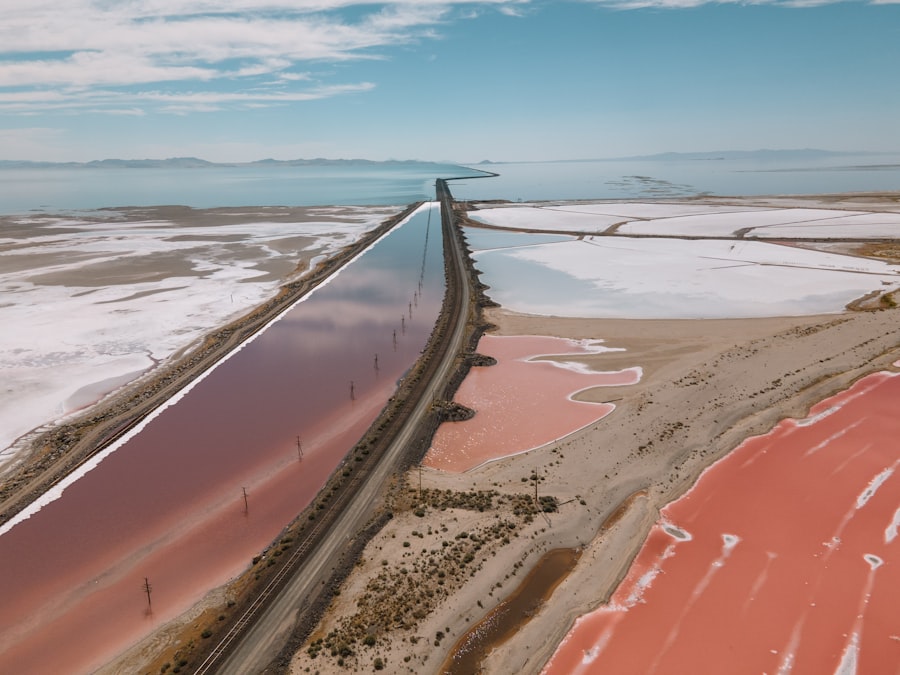
A pivotal human intervention, the construction of the Transcontinental Railroad causeway in 1904, dramatically altered the hydrology and salinity dynamics of the Great Salt Lake, creating a significant divide.
The Causeway: A Barrier of Steel and Earth
The railroad causeway, built to create a shorter route across the lake, acts as a physical barrier between the northern and southern arms. This structure impedes the natural flow of water between the two sections, leading to divergent salinity levels.
A Tale of Two Arms: Salinity Disparity
The causeway has effectively created two distinct environments within the same lake.
The North Arm: A Brine Shrimp Superhighway
The North Arm is generally deeper and receives less freshwater inflow. Due to its relative isolation from significant freshwater sources and its larger surface area, evaporation rates are high, leading to extremely high salinity – often exceeding 25% salts by weight, making it almost inhospitable to most life forms.
The South Arm: A Delicate Balancing Act
The South Arm, in contrast, receives more significant freshwater inflow from rivers like the Bear, Weber, and Jordan rivers. However, the causeway restricts the flow of hypersaline water from the North Arm into the South Arm. While the South Arm is still considerably saltier than a typical freshwater lake, its salinity is generally lower, often fluctuating between 5% and 15% salts by weight. This lower salinity is crucial for the survival of its ecological inhabitants.
Freshwater Inflow: The Lifeline of the South Arm
The quantity and quality of freshwater entering the South Arm are paramount to regulating its salinity. These inflows are primarily dictated by precipitation and human water management practices.
The Great Rivers: Arteries of Life
Several major rivers act as arteries, delivering freshwater to the South Arm. These include:
- The Bear River: The longest river in Utah, it is a significant contributor of water to the northern end of the lake.
- The Weber River: Flowing from the Wasatch Mountains, it enters the southern part of the lake.
- The Jordan River: This river, formed by the outflow of Utah Lake, also contributes freshwater to the South Arm.
The Human Factor: A Tugging Tug-of-War
The water from these rivers, vital for the South Arm’s ecological health, is also heavily utilized by humans for agriculture, municipal purposes, and industrial needs. This creates a constant tug-of-war between the needs of the environment and the demands of human development.
Agricultural Demands: Thirsty Fields
Agriculture is a major water consumer in Utah. Irrigation for crops diverts substantial amounts of water that would otherwise flow into the lake. This diversion directly impacts the volume of freshwater available to dilute the salts in the South Arm.
Municipal and Industrial Use: A Growing Thirst
As Utah’s population grows, so does the demand for water for cities and industries. These diversions further reduce the freshwater inflow, putting additional pressure on the lake’s salinity.
Drought’s Shadow: A Lingering Threat
Periods of drought, exacerbated by climate change, significantly reduce precipitation and snowpack, leading to lower river flows. During these times, the freshwater arteries feeding the South Arm shrink, allowing salinity levels to creep upwards.
The salinity levels in the Great Salt Lake’s South Arm have been a topic of increasing concern, especially as they impact local ecosystems and water quality. For those interested in exploring this issue further, a related article can provide valuable insights into the ongoing changes in salinity and their implications. You can read more about it in this informative piece on MyGeoQuest, which delves into the environmental challenges facing this unique body of water.
Ecosystem Implications: Life on the Edge of Salinity
| Parameter | Value | Unit | Notes |
|---|---|---|---|
| Average Salinity | 150 | ppt (parts per thousand) | Typically higher than the north arm due to evaporation |
| Salinity Range | 120 – 270 | ppt | Varies seasonally and with water inflow |
| Temperature | 5 – 30 | °C | Seasonal variation affects salinity concentration |
| Water Depth | 1 – 3 | meters | Shallow depth contributes to high salinity |
| Evaporation Rate | 1.5 – 2.5 | meters/year | High evaporation increases salinity |
The salinity of the South Arm is not merely a chemical statistic; it is a crucial determinant of the lake’s vibrant, albeit specialized, ecosystem.
The Unsung Heroes: Brine Shrimp and Brine Flies
The South Arm, with its moderate salinity levels, supports a thriving population of brine shrimp (Artemia franciscana) and brine flies (Ephydra spp.). These organisms are the foundational pillars of the lake’s food web.
Brine Shrimp: The Lake’s Primary Producers
Brine shrimp, often referred to as “sea monkeys,” are microscopic crustaceans that feed on algae. They are incredibly resilient and can tolerate a wide range of salinity levels, but they have an optimal range. Their abundance in the South Arm is a direct indicator of its suitability for them.
Brine Flies: The Architects of the Shoreline
Brine flies, in their larval stage, graze on algae and microbial mats, playing a vital role in nutrient cycling. Their pupae also form important food sources for migrating birds.
The Avian Buffet: A Migratory Magnet
The insects and small crustaceans within the South Arm create an abundant food source for millions of migratory birds that visit the lake each year. This makes the Great Salt Lake a critical stopover point on the Pacific Flyway.
A Feeder Station for Feathered Friends
Birds such as eared grebes, phalaropes, and various shorebirds rely on the brine shrimp and brine flies for sustenance during their arduous migratory journeys. A significant increase in salinity can disrupt the food supply, threatening these populations.
The Domino Effect of Salinity Shifts
If salinity in the South Arm rises too high, it can lead to a collapse of the brine shrimp and brine fly populations. This, in turn, creates a scarcity of food for the birds, potentially leading to mass starvation and reduced breeding success. This ecological cascade highlights how interconnected the lake’s systems are.
The Peril of Hypersalinity: Pushing the Boundaries of Life
Exceeding the tolerance limits of these key species can have devastating consequences.
The Loss of Biodiversity: A Silent Extinction
As salinity increases, the diversity of life within the South Arm dwindles. Species that cannot adapt or tolerate the higher salt concentrations begin to disappear, leading to a less resilient and less functional ecosystem.
The Algal Bloom Conundrum: A Double-Edged Sword
In some instances, fluctuating salinity and nutrient levels can trigger algal blooms. While some algae are food for brine shrimp, excessive blooms can lead to oxygen depletion when they decompose, creating “dead zones” within the lake. This paradox illustrates the delicate balance required for a healthy ecosystem.
The Future of the South Arm: Navigating Towards Sustainability
The ongoing challenges to the South Arm’s salinity underscore the need for a comprehensive and sustainable approach to water management and conservation.
Conservation Efforts: A Collective Responsibility
Addressing the salinity issue requires a multi-pronged strategy involving all stakeholders.
Water Conservation: Every Drop Counts
Encouraging water conservation across all sectors – agriculture, industry, and households – is paramount. Implementing efficient irrigation techniques, adopting water-wise landscaping, and promoting responsible use can significantly reduce diversions.
Policy and Planning: A Vision for the Future
Effective water management policies are essential. This includes:
- Prioritizing lake inflows: Ensuring a minimum amount of freshwater reaches the lake, even during dry years, is crucial for maintaining ecological health.
- Integrated planning: Coordinating water use across different sectors and considering the long-term health of the Great Salt Lake in all water management decisions.
- Climate change adaptation: Developing strategies to mitigate the impacts of climate change, such as increasing drought frequency and intensity, on water availability.
Public Awareness and Education: Empowering Change
Raising public awareness about the critical importance of the Great Salt Lake, its ecological value, and the threats it faces is vital for fostering public support for conservation efforts and policy changes. Understanding the salinity of the South Arm is not just an academic exercise; it is a call to action. The shimmering waters of the Great Salt Lake’s South Arm are a delicate mirror reflecting our stewardship of this precious, finite resource.
FAQs
What is the Great Salt Lake South Arm?
The Great Salt Lake South Arm is the southern portion of the Great Salt Lake in Utah, known for its higher salinity levels compared to the northern arm due to limited water inflow and higher evaporation rates.
Why is the salinity of the South Arm higher than other parts of the Great Salt Lake?
The South Arm has higher salinity because it is separated from the main body of the lake by a railroad causeway, which restricts water flow and causes increased evaporation, concentrating the salts.
How does the salinity of the South Arm affect its ecosystem?
The elevated salinity limits the types of organisms that can survive there, favoring salt-tolerant species such as brine shrimp and certain types of algae, while excluding most freshwater species.
What factors influence the salinity levels in the Great Salt Lake South Arm?
Salinity levels are influenced by factors such as water inflow from rivers and streams, evaporation rates, precipitation, and the degree of water exchange with the northern arm of the lake.
Are there any environmental concerns related to the salinity of the South Arm?
Yes, changes in salinity can impact the lake’s ecology, including the health of brine shrimp populations and bird habitats, and can also affect mineral extraction industries that rely on the lake’s unique chemical composition.