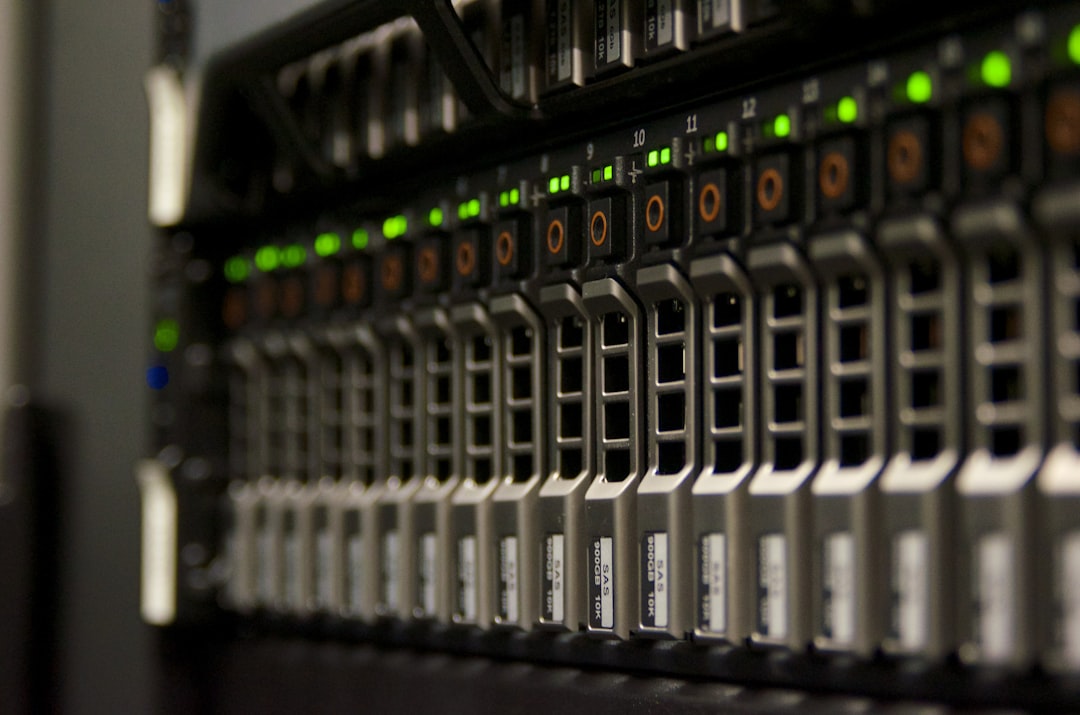
Fiber optic cabling forms the fundamental communication backbone of any hyperscale data center. Its efficient design and management are critical for achieving the high bandwidth, low latency, and operational reliability that these massive facilities demand. Optimizing fiber routing is not merely an aesthetic consideration; it directly impacts performance, cost, scalability, and maintenance. This article explores the key aspects of optimizing fiber routing in hyperscale data centers, moving beyond superficial arrangements to a strategic approach that balances numerous technical and logistical factors.
Hyperscale data centers are characterized by their vast scale, housing hundreds of thousands and even millions of servers, storage devices, and networking components. They are designed for rapid deployment, high availability, and cost-efficiency. The sheer density of equipment and the continuous flow of data necessitate a robust and meticulously planned infrastructure.
The Network Architecture Landscape
Within a hyperscale environment, several distinct network architectures exist, each with its own routing implications:
Spine-Leaf Topology: High Bandwidth, Predictable Latency
The prevalent spine-leaf architecture, also known as a Clos network, is designed to provide predictable latency and high bisectional bandwidth. In this design, all leaf switches are connected to all spine switches. This creates a non-blocking or near non-blocking network, ensuring that any server can communicate with any other server with a consistent number of hops.
Implications for Fiber Cabling
- High Port Density: Leaf switches, often in high-density configurations, require a significant number of fiber connections to the top-of-rack (ToR) switches or aggregation points. Spine switches, conversely, aggregate traffic from many leaf switches, demanding even higher density and robust cabling solutions.
- Structured Cabling: The highly structured nature of spine-leaf necessitates predictable and organized fiber runs. Each leaf switch’s connection to each spine switch needs to be accounted for.
- Emerging Interconnects: As speeds increase (e.g., 400GbE, 800GbE), the physical density of fiber connections per port can increase, placing further demands on routing and space management.
Traditional Hierarchical Models: Less Common, Specific Use Cases
While spine-leaf is dominant, some legacy or specialized hyperscale deployments might still incorporate elements of traditional three-tier hierarchical networks (core, aggregation, access). These models present different routing challenges due to the inherent bottlenecks at aggregation layers.
Implications for Fiber Cabling
- Concentration Points: Traditional models often involve significant fiber concentration at aggregation and core layers, demanding high-capacity trunking and careful management to avoid congestion.
- Longer Runs: In some cases, access layer devices might be physically more distant from aggregation points, leading to longer fiber runs with potential signal degradation considerations.
Environmental Factors and Space Constraints
Hyperscale data centers are complex environments with stringent requirements for cooling, power, and physical accessibility. These factors directly influence fiber routing decisions.
Rack and Row Layouts
The physical arrangement of server racks and rows is a primary determinant of cable pathways. Efficient routing must consider aisle space, cable tray capacity, and the proximity of equipment.
Considerations for Routing
- Service Aisles vs. Cold/Hot Aisles: Designating specific aisles for equipment service and others for airflow management is crucial. Fiber routing must avoid obstructing airflow and allow for technicians to safely access equipment.
- Rack Density: The density of equipment within racks dictates the number of connections emanating from them, directly impacting the required cable capacity from each rack.
Cable Management Systems
Robust cable management is not an afterthought but an integral part of fiber routing optimization. This includes trays, conduits, raceways, and even intelligent fiber management solutions.
Types of Management Systems
- Overhead Cable Trays: Commonly used for distributing cables throughout the data hall. Their capacity, load-bearing capabilities, and ease of access are critical.
- Underfloor Cabling: While less common in modern hyperscale designs due to air plenum considerations, underfloor routing is still an option in some facilities.
- Rack-Level Management: Bundles, organizers, and internal routing within racks are essential to prevent visual clutter and physical strain on fiber connectors.
For those interested in the intricacies of hyperscale data center fiber routing, a related article can be found at MyGeoQuest, which delves into the latest advancements and best practices in fiber optic infrastructure. This resource provides valuable insights into optimizing data flow and enhancing connectivity within large-scale data environments, making it essential reading for professionals in the field.
Strategic Fiber Path Planning
Effective fiber routing begins with a strategic plan that considers the present needs and future scalability requirements of the data center. This involves a systematic approach to determining cable lengths, pathways, and termination points.
Design Principles for Fiber Pathways
Adhering to established design principles ensures that fiber infrastructure is not only functional but also maintainable and adaptable.
Minimizing Bend Radius Violations
Fiber optic cables have a minimum bend radius to prevent signal loss and physical damage. Exceeding this radius can significantly degrade performance.
Practical Implementation
- Gentle Curves: Routing should incorporate gradual bends rather than sharp, acute angles.
- Clever Use of Space: Strategic placement of equipment and cable management hardware can create natural pathways that respect bend radius constraints.
- Pre-terminated Cables and Patch Panels: Using pre-terminated fiber optic cables with appropriate lengths and high-density patch panels can simplify installation and management while minimizing the need for field fiber termination, which can be prone to exceeding bend radii.
Balancing Cable Length and Signal Integrity
While shorter cable runs are generally preferred for minimal attenuation, extremely dense environments may necessitate longer runs. The goal is to find an optimal balance.
Attenuation and Distance
- Fiber Type Selection: The type of fiber optic cable (e.g., single-mode vs. multi-mode, specific grades of each) plays a significant role in its attenuation characteristics and maximum supported distances.
- Quality of Components: The quality of connectors, splices, and patch panels also influences signal integrity over distance.
Standardization and Modularity
A standardized approach to fiber routing and cabling infrastructure facilitates easier deployment, troubleshooting, and future upgrades. Modularity allows for flexibility and adaptation.
Benefits of Standardization
- Reduced Complexity: Consistent labeling, color-coding, and pathway designs simplify operations.
- Interoperability: Adherence to industry standards ensures compatibility with different vendors’ equipment.
- Scalability: Modular designs allow for adding capacity without major infrastructure overhauls.
Network Topology Integration
The specific network topology employed dictates the demands placed on fiber routing. Understanding these demands is crucial for effective planning.
Spine-Leaf Fiber Interconnects
In a spine-leaf architecture, the primary fiber routing challenge lies in connecting each leaf switch to every spine switch.
Routing Considerations
- Cable Trays Between Racks: Dedicated cable trays are typically routed between the racks housing leaf switches and the racks housing spine switches.
- Quadrant or Zone-Based Routing: Larger data centers may divide cabling into zones or quadrants to manage complexity and ensure efficient pathways.
- High-Density Connectors: The use of MPO/MTP connectors becomes prevalent to terminate multiple fibers within a single connector, reducing the physical footprint and simplifying connections.
Top-of-Rack (ToR) to Leaf Switch Connectivity
The connection between servers within a rack and the ToR switch, and subsequently from the ToR to the leaf switch, represents a significant portion of the overall fiber deployment.
Management of Short Runs
- Within-Rack Cabling: Careful management of fiber optic patch cords within the rack is essential to prevent tangling and strain.
- ToR Switch to Leaf Switch Links: These runs typically traverse a shorter distance, but the sheer number of connections requires efficient cable tray utilization and clear pathway demarcation.
Cable Management and Containment
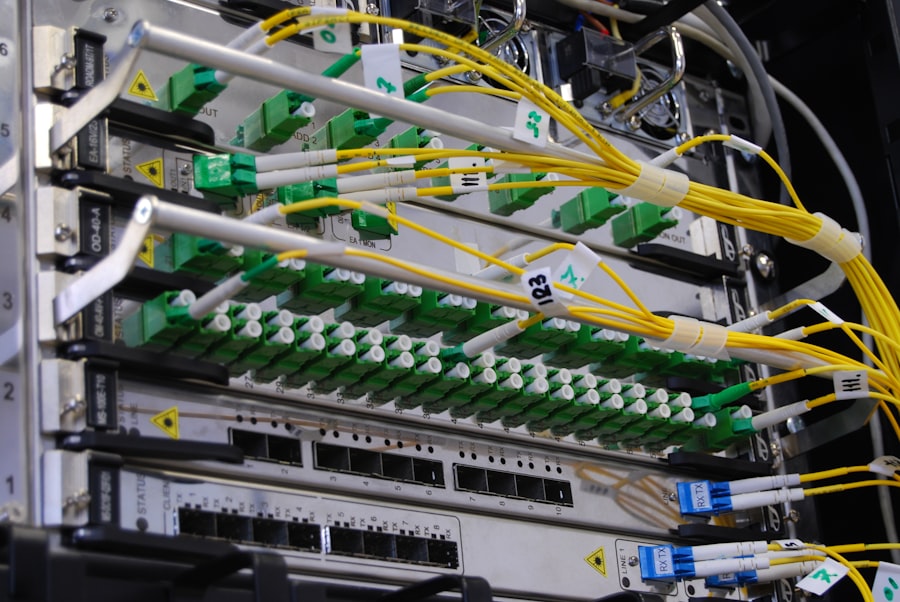
Effective cable management is paramount in hyperscale environments to ensure airflow, accessibility, and the longevity of the fiber optic infrastructure.
Horizontal and Vertical Cable Management
Both horizontal and vertical pathways require dedicated management solutions to organize and protect fiber optic cables.
Horizontal Pathway Design
This refers to the routing of cables along rows and across the data hall.
Best Practices
- Distributed Cable Trays: Using a network of interconnected cable trays to guide cables from equipment racks to distribution points.
- Clear Labeling: Every section of the cable tray and every bundle of cables should be clearly labeled with origin and destination information.
- Capacity Planning: Ensuring that cable trays are not overloaded, allowing for future growth and the addition of new cables.
Vertical Pathway Design
Vertical management is critical for guiding cables from overhead trays down into equipment racks and for managing connections within the rack itself.
Rack-Level Solutions
- Vertical Cable Managers: These are typically mounted on the sides of equipment racks to organize the vertical runs of fiber optic cables.
- Zero-U Managers: Devices that mount in the unused rack space (0U) to provide organized pathways for cabling.
- Cable Spines and Fingers: Flexible elements that guide cables from the tray to individual devices within the rack.
Airflow Management and Fiber Obstruction
Fiber optic cables, if not properly managed, can obstruct critical airflow pathways, leading to performance degradation and equipment overheating.
Impact on Cooling Efficiency
- Blockage of Airflow: Uncontrolled cable bundles can act as barriers to cold air supply or hot air exhaust, disrupting the designed airflow within the data center.
- Increased Temperature Gradients: This leads to localized hot spots that can stress equipment and reduce its lifespan.
Routing to Minimize Airflow Disruption
- Dedicated Pathways: Designing fiber pathways that are separate from primary airflow routes whenever possible.
- Compact Cable Management: Utilizing high-density management solutions that minimize the physical footprint of cable bundles.
- Regular Audits: Periodically inspecting cable management to ensure it is not impeding airflow.
Cable Types and Termination Strategies
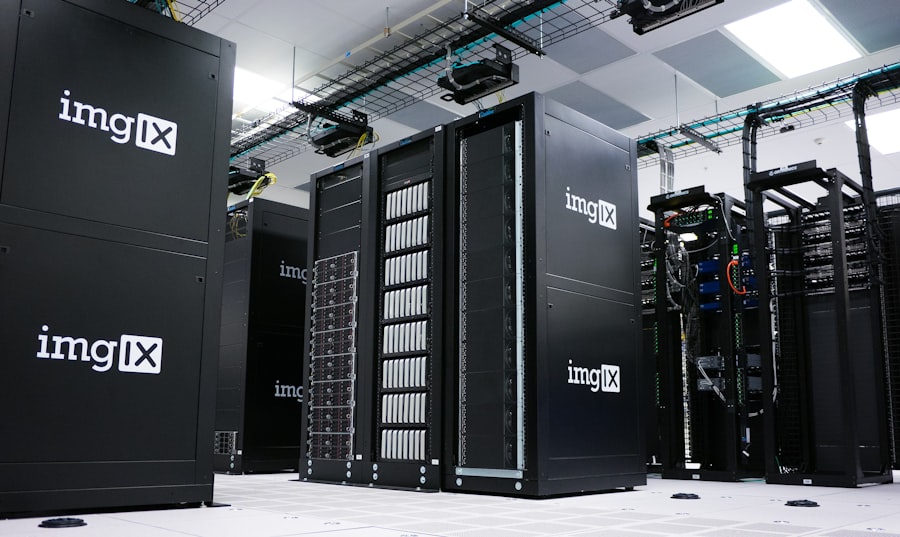
The selection of appropriate fiber optic cable types and termination strategies significantly impacts performance, scalability, and cost.
Fiber Optic Cable Selection
Different types of fiber optic cables are suited for different applications and distances within a hyperscale data center.
Single-Mode Fiber (SMF)
SMF is characterized by its small core diameter, allowing light to travel in a single mode. It is ideal for long-distance, high-bandwidth applications.
Use Cases in Hyperscale
- Inter-Building Connectivity: For connecting different data halls or facilities.
- Longer Backbone Links: Within large data centers where distances between aggregation points or spine switches exceed typical multi-mode limits.
- Future-Proofing for Extremely High Bandwidths: As speeds continue to increase, single-mode is often the preferred choice for its inherently greater bandwidth capacity over distance.
Multi-Mode Fiber (MMF)
MMF has a larger core diameter, allowing light to travel in multiple modes. It is generally more cost-effective for shorter distances.
Common Deployments
- Within-Rack Connectivity: For connecting servers to ToR switches.
- ToR to Leaf Switch Links: In many hyperscale deployments, the distances for these connections are within the effective range of modern MMF (e.g., OM4 or OM5).
- Data Hall Backbone: For shorter backbone runs where cost is a significant factor and the required bandwidth can be met.
Termination and Connector Technologies
The choice of connectors and termination methods is as important as the cable itself.
High-Density Connector Solutions
The increasing density of network ports necessitates the use of high-density fiber optic connectors.
MPO/MTP Connectors
- Functionality: MPO (Multi-fiber Push On) connectors house multiple fibers (e.g., 12, 24, 48, 72) within a single connector housing. MTP is a brand of high-performance MPO connector.
- Advantages: Significantly reduces the number of individual cables and connectors required, streamlining installation and reducing space requirements.
- Applications: Ideal for high-bandwidth links between spine and leaf switches, and for backbone connections where trunking is employed.
Traditional LC Connectors
LC (Lucent Connector) connectors are still widely used for individual fiber connections.
When LC is Preferred
- Individual Port Connections: For device-to-device connections where a multi-fiber connector is not warranted.
- Legacy Systems: Compatibility with existing infrastructure.
- Troubleshooting Simplicity: For some technicians, individual LC connections may be perceived as easier to manage and troubleshoot in lower-density scenarios.
Pre-terminated Cabling vs. On-Site Fusion Splicing
The decision between using pre-terminated fiber optic cables and performing on-site fusion splicing has significant implications for deployment time, cost, and quality.
Pre-terminated Cabling
Factory-terminated cables come with connectors already attached to both ends.
Pros and Cons
- Advantages: Rapid deployment, consistent connector quality from the factory, simplified installation process, reduced need for specialized tools on-site.
- Disadvantages: Can be less flexible for highly complex or non-standard routing, potential for shipping damage if not handled carefully, lead times for custom lengths.
On-Site Fusion Splicing
Fusion splicing involves joining two fiber ends together using an electric arc.
Pros and Cons
- Advantages: High degree of flexibility for custom lengths and routing, potentially lower material cost for raw fiber, suitable for situations where pre-terminated cables are impractical.
- Disadvantages: Requires specialized equipment and skilled technicians, can be time-consuming on-site, fusion splices can be susceptible to environmental factors if not properly protected, quality is highly dependent on technician skill.
In the rapidly evolving landscape of hyperscale data centers, efficient fiber routing plays a crucial role in optimizing performance and reducing latency. A recent article explores innovative strategies for enhancing fiber management in these large-scale facilities, highlighting the importance of proper planning and implementation. For more insights on this topic, you can read the full article on fiber routing techniques that are shaping the future of data center operations.
Future-Proofing and Scalability Considerations
| Data Center | Number of Fiber Routes | Maximum Capacity (Tbps) |
|---|---|---|
| Data Center A | 4 | 12 |
| Data Center B | 6 | 18 |
| Data Center C | 8 | 24 |
Hyperscale data centers are dynamic environments. Fiber routing strategies must be designed with the future in mind, anticipating increasing bandwidth demands and evolving technologies.
Planning for Increased Bandwidth
The trend in hyperscale data centers is towards ever-increasing bandwidth per port and per server. Fiber routing must accommodate this evolution.
Evolution of Speeds (100GbE, 400GbE, 800GbE and beyond)
As network speeds increase, the number of fiber strands required per link may change, or the density of connectors will become even more critical.
Implications for Routing
- Higher Port Density per Switch: Switches with higher bandwidth per port often have more compact optical modules, requiring more fibers to be routed to them.
- Consolidation of Links: High-speed links might aggregate multiple lower-speed links, demanding higher capacity trunking.
- Emergence of New Fiber Types or Standards: Future higher speeds might necessitate or benefit from specific fiber types or connector standards not yet widely adopted.
Modular and Flexible Infrastructure
A modular design allows a data center to adapt and scale without significant disruption.
Designing for Additive Capacity
Fiber routing should be planned in such a way that new cable pathways and management systems can be easily integrated as capacity needs grow.
Strategic Pathway Design
- Undersized for Future Growth: Designing cable trays and conduits with sufficient unused capacity from the outset.
- Modular Management Systems: Utilizing cable management solutions that can be expanded or reconfigured.
- Clear Demarcation Points: Establishing logical and physical demarcation points for different network segments, making it easier to add or reroute cables.
Documentation and Lifecycle Management
Comprehensive documentation and ongoing lifecycle management are crucial for maintaining an optimized fiber infrastructure over time.
Maintaining Accurate Network Diagrams
Detailed and up-to-date documentation is essential for understanding the existing fiber infrastructure.
Key Documentation Elements
- Cable Pathways: Visual representations of all fiber optic cable runs.
- Termination Points: Mapping of all patch panels, connectors, and equipment ports.
- Cable Type and Length: Recording the type and length of every fiber optic cable installed.
- Labeling Schemes: A clear explanation of the labeling conventions used throughout the data center.
Regular Audits and Maintenance
Periodic audits help identify potential issues and ensure that the fiber infrastructure remains optimized.
Audit Focus Areas
- Cable Strain and Damage: Identifying any cables that are stressed or damaged.
- Airflow Obstructions: Verifying that the fiber infrastructure is not impeding cooling.
- Documentation Accuracy: Ensuring that the current physical infrastructure matches the documented records.
- Capacity Utilization: Monitoring the usage of cable trays and management systems to plan for future expansion.
In conclusion, optimizing fiber routing in hyperscale data centers is a multifaceted challenge that requires a strategic, data-driven approach. It involves careful consideration of network architecture, environmental factors, design principles, cable technologies, and future scalability. By investing in intelligent planning and robust management, hyperscale operators can ensure their fiber optic infrastructure remains a reliable and high-performance foundation for their critical operations.
FAQs
What is a hyperscale data center?
A hyperscale data center is a facility owned and operated by a company that provides cloud computing and internet services on a large scale. These data centers are designed to be highly scalable and can accommodate the growing demands of cloud computing and big data processing.
What is fiber routing in a hyperscale data center?
Fiber routing in a hyperscale data center refers to the process of designing and implementing the network infrastructure that connects the various components of the data center using fiber optic cables. This includes routing the fiber cables to ensure efficient and reliable connectivity between servers, storage systems, and networking equipment.
Why is fiber routing important in hyperscale data centers?
Fiber routing is important in hyperscale data centers because it plays a critical role in ensuring high-speed, low-latency, and reliable connectivity between the different components of the data center. Efficient fiber routing is essential for supporting the massive data processing and storage requirements of hyperscale data centers.
What are the key considerations in hyperscale data center fiber routing?
Key considerations in hyperscale data center fiber routing include the design of the fiber optic network to support high bandwidth and low latency, the use of redundant paths for resilience and reliability, and the implementation of efficient cable management and routing to minimize signal degradation and maintenance challenges.
How does hyperscale data center fiber routing impact overall data center performance?
Efficient fiber routing in hyperscale data centers can significantly impact overall data center performance by enabling high-speed data transfer, low-latency communication between servers and storage systems, and reliable connectivity for cloud computing and big data processing applications. Proper fiber routing can also contribute to improved energy efficiency and reduced operational costs.